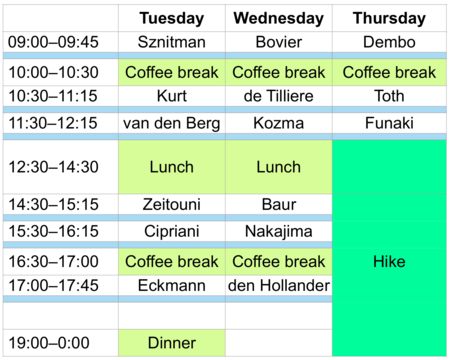
Sznitman - Effective energy-enstrophy diffusion and inviscid condensation
We use Gaussian measure on RN to define a stationary diffusion process on a cone of R². This diffusion is the inviscid limit of the laws of the “enstrophy-energy” process of an N-dimensional Galerkin-Navier-Stokes type evolution with Brownian forcing and random stirring, regardless of the strength of the stirring. With the help of this two-dimensional diffusion process, we infer quantitative condensation bounds, which for suitable forcings show an attrition of all but the lowest modes in the inviscid limit. Based on joint work with Klaus Widmayer (U. Zurich).
Kurt - On the multitype Bolthausen-Sznitman-coalescent and its relatives
The Bolthausen-Sznitman coalescent and its connection with Neveu’s continuous state branching process was the starting point of a series of papers by Bertoin and Le Gall on the many relations between multiple merger coalescents (Λ-coalescents) and continuous state branching processes (CSBPs). In this talk, we consider multitype Λ-coalescents that were recently characerized by Johnston, Kyprianou and Rogers. We present several connections with multitype CSBPs. Our main results are a moment duality between the block-counting process of a multitype Λ-coalescent and a multitype Λ-Wright-Fisher frequency process, and a homeomorphism between the (parameter) space of multitype Λ-coalescents and that of multitype CSBPs. Moreover we construct a discrete approximation of the frequency process of a multitype CSBP that converges to the frequency process appearing in the duality result. This ``sequential sampling’’ approximation is one of our main tools in the proofs. With these results, we can in particular define ``genuinely multitype’’ Beta-coalescents.
van den Berg - On the torsion function for simply connected, open sets in ℝ2
For a non-empty, open set Ω ⊂ ℝ2, let λ(Ω) denote the bottom of the spectrum of the Dirichlet Laplacian acting in L2(Ω). Let wΩ be the torsion function for Ω, and let ∥·∥p denote the Lp norm. It is shown there exists η > 0 such that ∥wΩ∥∞ λ(Ω) ≥ 1 + η for any non-empty, open, simply connected set Ω ⊂ ℝ2 with λ(Ω) > 0. Moreover, if in addition the measure |Ω| of Ω is finite, then ∥wΩ∥1 λ(Ω) ≤ (1 - η)|Ω|. Joint work with Dorin Bucur, Université de Savoie.
Zeitouni - 2D polymers and log-correlated fields
I will review some recent work concerning the extrema of partition functions of 2D polymers in random environments, in the subcritical and critical regimes. Joint work with Clement Cosco and Shuta Nakajima.
Cipriani - Towards a phase transition for the integer-valued membrane model
In this talk we study the integer-valued membrane model on a finite box of the integer lattice at inverse temperature \beta. This is a random interface with bilaplacian energy constrained to the integers. For any temperature and any test function, the model has sub-Gaussian upper bounds on the tails. In dimensions 2\le d\le 4 we prove matching lower bounds for a broad class of localized test functions in a high-temperature regime in which the inverse temperature is allowed to depend on the box size and as such we identify a smallness condition on the inverse temperature under which the lower bound holds. Joint work with B. Dan (IISER Kolkata) and R. S. Hazra (Leiden University).
Eckmann - Bottlenecks in Sierpinski Sandpiles
This is work in progress with Tatiana Smirnova-Nagnibeda. We consider avalanches in finite Sierpinski lattices. While the power law distributions of (large) avalanche sizes are fairly well understood, we wondered about the somewhat irregular distribution of short avalanche sizes. I think we "understand" what is happening, but proofs are missing.
Bovier - Using Feynman-Kac for systems of non-linear reaction-diffusion equations
Almost 50 years ago, Murray Bramson showed how the use of the Feynman-Kac representation for linear PDEs can also give very precise results on the analysis of non-linear PDEs, notably the F-KPP equation. In this talk, I will discuss the possibility of using Feynman-Kac also for systems of coupled F-KPP equations. In a particular case, I will show that this can not only provide nice results on the behaviour of wave speeds, but also very intuitive explanations. I will also discuss some ongoing work and open problems. This is joint work with Lisa Hartung.
de Tilliere - Fock's dimer model on the Aztec diamond & beyond
We consider the dimer model, or equivalently domino tilings, on the Aztec diamond, and suppose that edges are assigned Fock's weights. The main goal of this talk is to give a compact, explicit formula for the inverse Kasteleyn matrix, thus extending in this very general context previous results of the same kind; in particular, this gives an explicit expression for Boltzmann probabilities. Then, we will prove that the partition function admits a product form, and show how to recover Stanley's celebrated formula as a specific case. This is based on a joint work with Cédric Boutillier. I will also mention a work in progress with Cédric Boutillier and Bishal Deb, aiming at extending this result to a general class of graphs arising from the octahedron recurrence, known as Speyer graphs.
Kozma - Once Reinforced Random Walk in high dimensions
Once reinforced random walk is the simplest imaginable self-interacting random walk. The walker has a slight preference to edges it visited before, regardless of how many times it visited them. A conjecture of Vladas Sidoravicius is that in dimension d>2 the process has a phase transition in the strength of the reinforcement. We will discuss a recent result that in d≥6 the process has a transient phase. Joint work with Dor Elboim.
Baur - Step-reinforced random walks with fading memory
Originating from the Elephant Random Walk introduced by Schütz and Trimper in 2004, step-reinforced random walks are stochastic processes with a memory of their preceding steps. I will discuss a model with fading memory, which covers both the situation where steps from the remote past and from the more recent past tend to be forgotten. Based on joint work with Marco Bertenghi.
Nakajima - Recent Progress on the Ising Perceptron
The Ising perceptron is a fundamental model in statistical learning and spin glass theory. In this talk, I will mainly discuss mathematical progress on this model. As a recent development, I will present recent results on the uniqueness of the replica symmetric saddle point.
den Hollander - Challenges in co-evolution on networks
In this talk I present an overview of what is known and is not known about random processes on dynamic random graphs in co-evolution, i.e., with mutual feedback. The literature offers plenty of
heuristics, simulations and conjectures, but so far mathematical results are extremely scarce. I describe some of these results, with a focus on opinion dynamics. In particular, I consider random
graphs in which vertices can have one of two possible opinions. Pairs of vertices connected by an edge share their opinions according to a rate that may depend on the size of the graph. Each edge
turns on or off according to a rate that depends on whether the vertices at its two endpoints have the same opinion or not. I exhibit joint evolution equations and describe the occurrence of phase
transitions between consensus and polarisation.
Dembo - Disordered Gibbs measures and Gaussian conditioning
Given a Gaussian energy function H(x) and a random process F(x) defined on the same configuration space, what is the law of F(y) for y sampled from the disordered Gibbs measure associated with H(x)? In joint work with Eliran Subag, we resolve this at the high-temperature phase in a general setting, and in the more challenging low-temperature phase for spherical spin glasses. The answer is given in terms of the law of F(x) for deterministic x, conditional on an appropriate event. In the former case the conditioning involves only the value of H(x) at the same point x, while in the latter, we must specify also the energy and its derivatives over a sequence of critical points of certain geometry (which is induced by the model's type of replica-symmetry-breaking).
Toth - The Pólya Web
The Pólya Walk is an up-right random walk on the discrete quadrant ℕ × ℕ which mimics the trajectory of the simple Pólya Urn. The Pólya Web is the joint realization of independent and coalescing Pólya Walks starting from all points of the discrete quadrant. We consider and partly answer various natural questions related to this object. Based on joint work (in progress) with Balázs Bárány, Piotr Śniady and Ákos Urbán.
Tadahisa Funaki (BIMSA) - Decoupleability of coupled KPZ equation
We consider the coupled KPZ equation with coupling constants given by a completely symmetric n×n×n tensor. We study its full and partial decoupleability under the action of O(n), taking advantage of the O(n)-invariance of space-time Gaussian white noise. For n=2, a direct calculation provides a complete criterion for decoupleability. For n\ge 3, our analysis is based on classical invariant theory dating back to Hilbert. Joint work with Sunder Sethuraman, Shankar Venkataramani, Boliang Fu and Kotaro Kawai.